
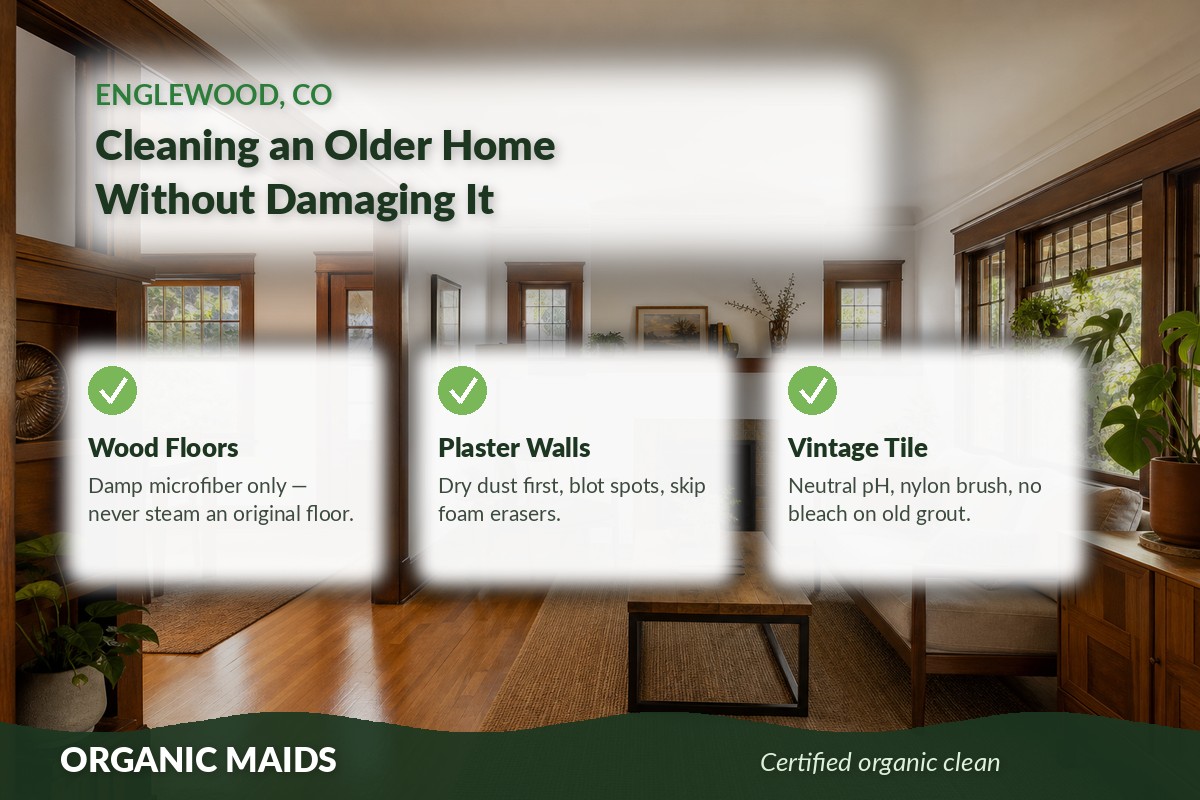
Cleaning Older Englewood, CO Homes: A Pro’s Guide
- Identify finishes in Englewood homes: water drop test; treat waxed, polyurethane, or engineered floors differently; never steam clean old floors.
- Use minimal water and pH-neutral cleaners on plaster walls and trim; blot stains, never saturate, avoid melamine foam.
- Clean vintage tile and grout with neutral pH and nylon brushes; use non-abrasive cream on cast iron tubs; reglaze if enamel is gone.
- Damp-wipe to control dust, vacuum radiators and registers, rinse screens, fix basement moisture, and hire pros like Organic Maids for deep resets.
Englewood has some of the most characterful housing stock in the Denver metro. Walk the blocks around Old Hampden Avenue, the bungalows near Cushing Park, or the brick ranches south of Broadway and you are looking at homes built anywhere from the 1920s through the 1960s. They have solid bones, original oak floors, plaster walls, cast iron tubs and small hexagonal bathroom tile.
They also do not respond to cleaning the way a 2015 build does. Products that are perfectly safe on modern engineered surfaces can strip, cloud or stain the materials in an older Englewood home. After years of cleaning homes across Englewood — from rentals near the light rail corridor to family homes near Swedish Medical Center — our teams have a distinct playbook for older houses. This guide shares it.
House Cleaning in Englewood, CO: Start by Identifying Your Finishes
The single most useful thing you can do before cleaning an older home is figure out what you actually have. The same “wood floor” can be three completely different maintenance problems:
- Original hardwood with wax or shellac (pre-1950s). Water beads slowly and the floor has a soft, warm sheen. Wet mopping will cloud it. Use a barely damp microfiber and a pH-neutral cleaner, or a solvent-free wax refresher.
- Site-finished polyurethane (common in 1960s–1990s refinishes). Water beads and wipes clean. Damp mopping is fine; steam is not.
- Engineered or laminate (later remodels). Minimal moisture only, seams are the weak point.
A simple test: put a drop of water in an inconspicuous corner. If it soaks in and darkens the wood within a minute, you have a worn or wax finish, and moisture is your enemy. If it sits as a bead, you have an intact film finish.
Never steam-clean an old wood floor
Steam mops are marketed as chemical-free, which sounds ideal for a health-conscious household. On a hundred-year-old floor, forced steam drives moisture through gaps between boards into the subfloor, lifting the finish and cupping the planks. We have seen the damage, and it is expensive. Damp microfiber, always.
Plaster Walls Are Not Drywall
Most pre-1950 Englewood homes have lath-and-plaster walls. Plaster is porous and often finished with older calcimine or oil-based paint that does not tolerate wet washing. Practical rules:
- Dry-dust walls first with a microfiber flat mop, top to bottom, before any spot cleaning.
- Spot clean with a barely damp cloth and blot — do not saturate. Water can dissolve the paint binder and leave a permanent halo.
- Never use a melamine foam eraser on flat or matte older paint. It abrades the surface and creates a shiny patch that looks worse than the mark.
- Hairline cracks are normal in plaster and are not a cleaning problem. Wiping them repeatedly widens them.
In homes that still have original picture rails and heavy trim, dust accumulates on the top edge of every horizontal profile. That upper band of trim is the difference between a house that looks clean and one that looks genuinely maintained, and it is the most commonly skipped area we find.
Vintage Bathrooms: Hex Tile, Cast Iron and Chrome
Older Englewood bathrooms are usually small, tiled, and original — which makes them charming and fragile at the same time.
Hexagonal and subway tile
The tile itself is durable, but the grout between small tiles is extensive and often unsealed. Clean with a pH-neutral cleaner and a nylon grout brush; avoid bleach-heavy products, which can lighten grout unevenly and leave a mottled look you cannot reverse.
Cast iron tubs with worn porcelain enamel
If the tub bottom feels slightly rough or looks matte compared to the sides, the enamel has lost its glaze. Abrasive powders accelerate that. Once enamel is porous, it holds stains, and every aggressive cleaning makes the next stain easier to set. Use a non-abrasive cream cleanser and a soft pad. If a tub is already dull, a professional reglaze is the real fix; no cleaner restores glaze.
Original chrome and nickel fixtures
Old chrome plating is thin. Skip acidic descalers on it and use a soap solution with patient repeat passes. For a nickel finish, test any product in a hidden spot first — discoloration is not reversible.
The Air Quality Issue Specific to Older Homes
Older houses in Englewood often have original ductwork, less insulation, and single-pane or early replacement windows. That combination means more dust infiltration, more temperature-driven air movement, and more particulate circulating through living spaces. Several practical implications:
- Dust settles faster and finer. Damp-wipe rather than dry-dust so particles are captured rather than launched back into the air. The EPA notes that source control and regular cleaning are the most effective ways to improve indoor air.
- Register and radiator interiors matter. Cast iron radiators collect a heavy dust layer on the interior fins that bakes and off-gasses odor when heat comes on in the fall. Late summer is the right time to vacuum them out with a crevice tool and a brush attachment.
- Basement humidity. Many Englewood basements are partially below grade with older concrete. Musty odor usually traces to a damp corner, not to the upstairs. Clean and dry the source rather than masking it with fragrance.
- Pre-1978 paint. Homes built before 1978 may contain lead paint. Do not sand or aggressively scrub flaking paint. Wet-wipe intact surfaces and consult a certified professional for anything deteriorating.
Kitchens That Have Been Remodeled Once or Twice
Older Englewood kitchens are often a mix of eras: original cabinet boxes with newer doors, mid-century tile counters with a modern sink, or vintage linoleum under a newer floating floor. Two things we watch for:
- Painted cabinet fronts. Degreasers formulated for modern laminate can soften older oil-based paint. Use a diluted plant-based soap solution and dry immediately, working with the grain.
- Grease film above the range. In kitchens with older or no ventilation, airborne grease builds up on the ceiling and upper cabinet faces. It needs an alkaline cleaner with dwell time — this is the one place in an old home where a stronger degreaser is the right call, applied to a cloth rather than sprayed onto the surface.
Windows, Screens and Late-Summer Prep
Older Englewood homes often have wood-sash windows with original hardware, and late August is the ideal time to clean them before storm windows or heating season. Wood sashes should be cleaned with a barely damp cloth and dried, never soaked, and glazing putty around the panes should be left alone if it is intact — scrubbing crumbles it. Painted sills that show chalky residue in a pre-1978 home should be wet-wiped only, never sanded.
Screens hold a surprising amount of the fine grit and pollen that drift across the south metro all summer. Removing them, rinsing with plain water and a soft brush, and letting them dry fully before reinstalling cuts indoor dust noticeably. It is one of the highest-return hours you can spend in an older house.
A realistic seasonal rhythm for an older home
- Weekly: damp microfiber dusting, vacuum with a HEPA filter, neutral-pH floor care.
- Monthly: trim tops and picture rails, door frames, light fixtures, baseboards.
- Seasonally: radiators and registers, window sashes and screens, grout brushing, basement corners.
- Annually: full deep clean, plus grout sealing where tile is original.
Where DIY Ends and a Professional Team Helps
Honestly, most of the routine work in an older home is DIY-friendly, and the techniques above are the whole secret: less water, neutral pH, patience instead of abrasion. Handle your own weekly upkeep with confidence.
Where a professional team earns its place in an older Englewood home:
- A first deep reset that gets trim tops, radiators, grout and light fixtures back to baseline — our deep cleaning service is built for exactly this
- Rental turnovers in Englewood’s many duplexes and older multi-family units, where move-out cleaning and apartment cleaning need to meet a landlord standard on a deadline
- Households with infants, older adults, or anyone with asthma, where product choice matters as much as technique
- Ongoing recurring house cleaning so dust never reaches the point where aggressive methods feel necessary
Why Product Choice Matters More in an Old House
In a modern home with sealed quartz and factory-finished floors, a harsh cleaner mostly poses an air quality question. In an older home it poses a materials question too: solvents dull wax finishes, bleach mottles unsealed grout, acids pit thin chrome, and ammonia clouds older paint. Certified organic, plant-based cleaners with a neutral pH are not just the family-safe choice here — they are usually the correct choice technically. You can see exactly what we use on our product ingredients page, and what a visit covers on our cleaning checklist.
Local Help for Your Englewood Home
Organic Maids cleans throughout Englewood and the south metro with certified organic, baby- and pet-safe products, background-checked W2 employees, and flat, upfront pricing. If your home has original floors, plaster or vintage tile, tell us during booking — our teams adjust methods accordingly.
See what is included on our Englewood, CO house cleaning services page, or get a flat-rate price in about a minute with an instant online quote. New clients can use promo code NEWCUSTOMER15 for 15% off a first service.
Share this article
Related Posts














Follow us
A quick overview of the topics covered in this article.