Cleaning Company vs Independent Cleaner in Littleton, CO
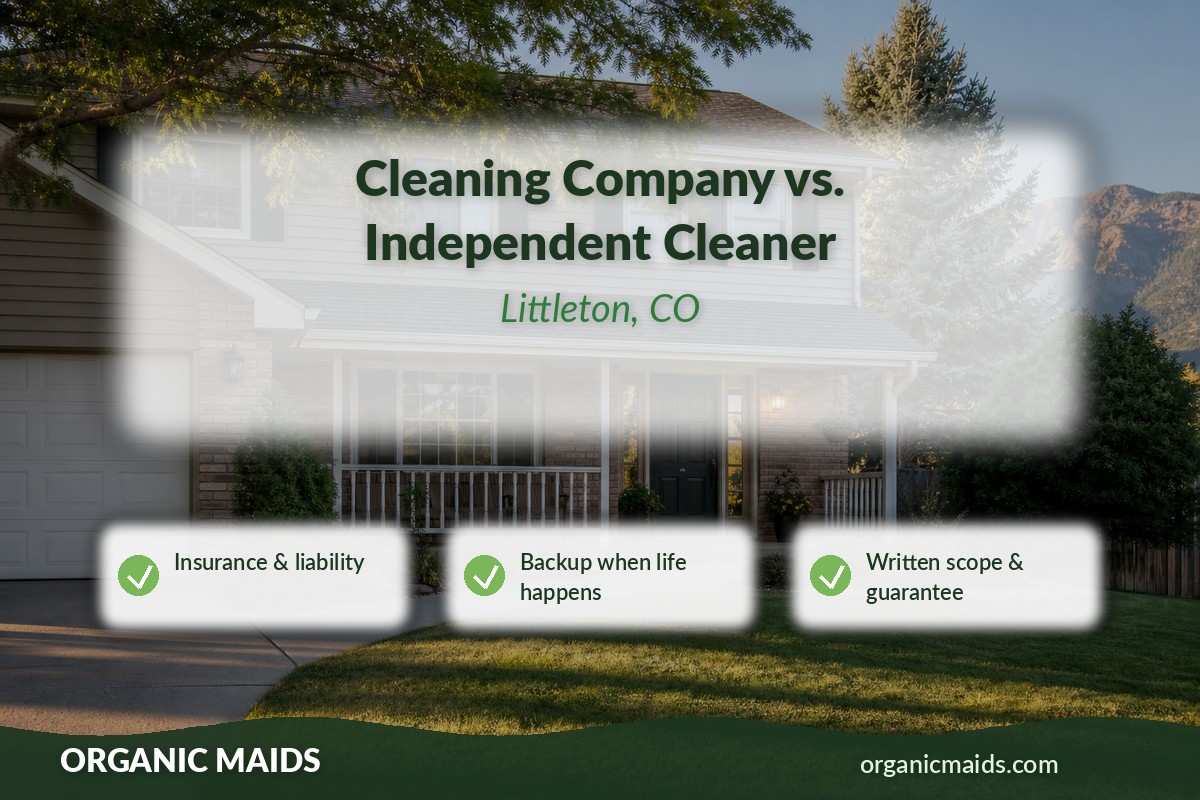
- Independent cleaners usually cost less per visit; companies' rates include payroll, taxes, vehicle fleets, and training.
- Ask for general liability and workers' compensation certificates; uninsured independents can leave claims on your homeowner's policy.
- Companies provide backup staff for sickness, vacations, and move-out deadlines; independents offer consistent single-person service.
- Choose independent for budget, same cleaner, or narrow tasks; choose a company for deadlines, large homes, or health-sensitive households.
- In Littleton, ask about hard-water scale, hardwood/LVP cleaning, soot handling, radon basements, and insist on an insured written scope.
Search “best house cleaning Littleton” and you get two very different kinds of results: cleaning companies with vans and websites, and individual cleaners recommended in neighborhood Facebook groups and on the Nextdoor feed for Ken Caryl or Columbine Valley. They are not the same product, and the cheaper one is not automatically the worse one.
We run a cleaning company, so treat this with the appropriate skepticism — but we have also lost bids to excellent independent cleaners and have recommended clients hire one. Here is a straight comparison of hiring a cleaning company vs. an independent cleaner in Littleton, what each is genuinely better at, and how to check either one before you hand over a key.
Cleaning Company vs. Independent Cleaner: The Real Differences
Ignore the marketing and the differences come down to five things.
1. Price
An independent cleaner is usually cheaper per visit — often noticeably. That is not a trick. A solo cleaner has no payroll taxes, no workers’ compensation premium, no dispatcher, no vehicle fleet, and no training program. A company’s rate carries all of that. Denver-metro ranges by home size and service type are in our 2026 house cleaning price guide; independents commonly sit below the low end of those ranges.
2. Insurance and liability
This is the difference most people discover too late. If a cleaner breaks a heirloom mirror, floods a laundry room, or is injured on your stairs, a bonded and insured company’s coverage responds. With an uninsured independent, the exposure typically lands on your homeowner’s policy — or on the cleaner personally, who may not be able to pay. Ask both types the same question: “Do you carry general liability and workers’ compensation, and can you send the certificate?” Some independents carry both. Many do not.
3. Coverage when life happens
A solo cleaner who gets the flu, takes a vacation, or breaks an ankle means you have no clean that week — and if it is a move-out clean scheduled the day before your walkthrough, that is a real problem. A company has bench depth. The trade-off is that you may not always get the identical person, which matters to some households a great deal.
4. Consistency and scope
A good independent who has cleaned your home for three years knows it better than any team will. That is a genuine advantage. What a company adds is a written scope, a repeatable checklist, and quality control that does not depend on one person’s memory or mood. Ours is published as a cleaning services checklist so nothing is ambiguous.
5. Background checks and hiring
Companies vary here, so do not assume. Ask whether cleaners are W2 employees or subcontractors and whether background checks are run. A company using subcontractors may offer no more vetting than an independent — it just looks more official. Organic Maids uses background-checked W2 employees and is bonded and insured.
When an Independent Cleaner Is the Better Choice for a Littleton Home
Honestly, hire an independent if:
- Budget is the binding constraint. A reliable independent every two weeks beats a company you cancel after two months because the total is uncomfortable.
- You want the same exact person, always. Some households — particularly older residents, or anyone with a specific routine — value one familiar face over redundancy.
- Your needs are narrow and unusual. Two hours of kitchen and bathrooms only, or laundry and tidying, is often something a solo cleaner will happily scope and a company will not.
- You have a strong personal referral from someone whose home you have actually seen, who has used them for a year or more.
In those cases, still verify insurance in writing and pay traceably. A referral is a reputation signal, not a background check.
When a Cleaning Company Is Worth the Premium
- Deadline-driven work. Real estate closings and lease turnovers are unforgiving; move-out cleaning has to happen on the assigned day, at full scope, with enough people to finish it.
- Larger homes. Once you are past roughly 3,000 sq ft — much of Ken Caryl Ranch, Chatfield Farms, and the newer Sterling Ranch builds south of C-470 — a solo cleaner needs seven or eight hours where a team of three needs two and a half.
- Health-sensitive households. If products matter to you because of asthma, a new baby, chemotherapy, or pets, you need a service that can name exactly what it uses and use it consistently.
- You do not want to be an employer. Paying an individual regularly can carry household-employer obligations. A company handles its own payroll, taxes, and insurance.
- You want recourse. A satisfaction guarantee only means something if there is an organization behind it.
Littleton-Specific Things to Ask About
Whoever you hire, these come up in homes here specifically:
- Hard water scale. Jefferson and Douglas County water leaves calcium on glass shower enclosures and chrome. Ask what they use. Correct answer: a mild acid — diluted citric or acetic acid, or a dedicated descaler — with dwell time. Wrong answer: an abrasive pad on glass, which micro-scratches it permanently and makes future scale stick faster.
- Hardwood and LVP floors. Common in Littleton’s 1970s–90s housing stock. Ask about a barely damp microfiber flat mop and a pH-neutral cleaner. Vinegar on site-finished hardwood dulls the finish over time; oil soaps leave a film that later refinishing has to fight.
- Wood-burning fireplaces and soot. Fine soot on a mantel or hearth surround must be vacuumed with a HEPA machine or lifted with a dry chemical sponge before anything wet touches it. Wiping first smears it into masonry.
- Dust from dry air and open space. With homes backing to South Platte Park and the foothills, fine grit comes in through window tracks and door sweeps. Ask whether window tracks and door frames are in scope or are an add-on.
- Radon-mitigation and finished basements. Many Littleton homes have finished lower levels that get cleaned on a partial rotation. Clarify whether the basement is every visit or every other — this is the single most common scope misunderstanding we fix.
Five Questions That Separate Good From Risky — Either Way
- “Are you insured, and will you email the certificate?” Documentation, not a verbal yes.
- “Who exactly will be in my home, and are they employees or subcontractors?”
- “What products do you use, and can I see the ingredients?” Anyone serious can answer immediately. Ours are published on our cleaning products and ingredients page.
- “What happens if I am not happy with a clean?” Listen for a specific remedy — a re-clean within a stated window — not reassurance.
- “How do you handle keys and access, and what if I need to reschedule?”
If you want a longer interview script, we wrote one for questions to ask before hiring a maid service.
Two Warning Signs, Regardless of Who You Hire
- A quote with no walkthrough, no photos, and no questions about home size or condition. A number produced with zero information is a number that will change on the day.
- Cash-only, no invoice, no written scope. You have no record of what was agreed and no recourse if something goes wrong.
One more that gets people: an unusually low price for a first “deep clean.” Deep cleaning is genuinely labor-heavy — inside appliances, grout, baseboards, light fixtures. A price far below the market for that scope usually means the scope is not really being performed. Our deep cleaning page spells out what is and is not included.
What a Good First Visit Looks Like
Whichever route you take, the first clean is the audition — and it should look different from every clean after it. Expect it to run longer, because the first visit absorbs everything that has accumulated since the last thorough clean: mineral scale in the showers, cooking film above the range, dust on the tops of door frames and ceiling-fan blades, and the grime line along baseboards in the hallway.
Good signs during that first visit: someone walks the home with you or asks about problem areas before starting; they work top-down and dry-to-wet, so dust falls onto floors that get cleaned last; microfiber is color-coded or swapped between bathrooms and kitchen rather than carried room to room; and cleaners let products dwell instead of spraying and instantly wiping. Disinfectants in particular need contact time to work — the CDC notes that cleaning to remove soil comes first, and that disinfectant labels specify how long a surface must stay wet.
Warning signs: the same cloth used on the toilet and the counter, heavy fragrance masking rather than removing odor, or a visit that finishes suspiciously early on a house that has not been professionally cleaned in months.
The Bottom Line for Littleton Homeowners
If your home is modest, your schedule is flexible, and you have a trusted referral, an insured independent cleaner is a perfectly sound choice and will likely cost less. If you have a deadline, a large or health-sensitive household, or you simply want the clean to happen whether or not one specific person is available that week, a company earns its premium — and you should hold it to a checklist, a guarantee, and named products.
If you would like to see what that looks like here, our Littleton, CO house cleaning services page covers our local scope, and our residential cleaning services page explains how recurring visits work. You can get a flat price in about a minute through our instant online quote — no walkthrough required, no sales call. New clients can use code NEWCUSTOMER15 for 15% off a first service.
Share this article
Related Posts










Follow us
A quick overview of the topics covered in this article.